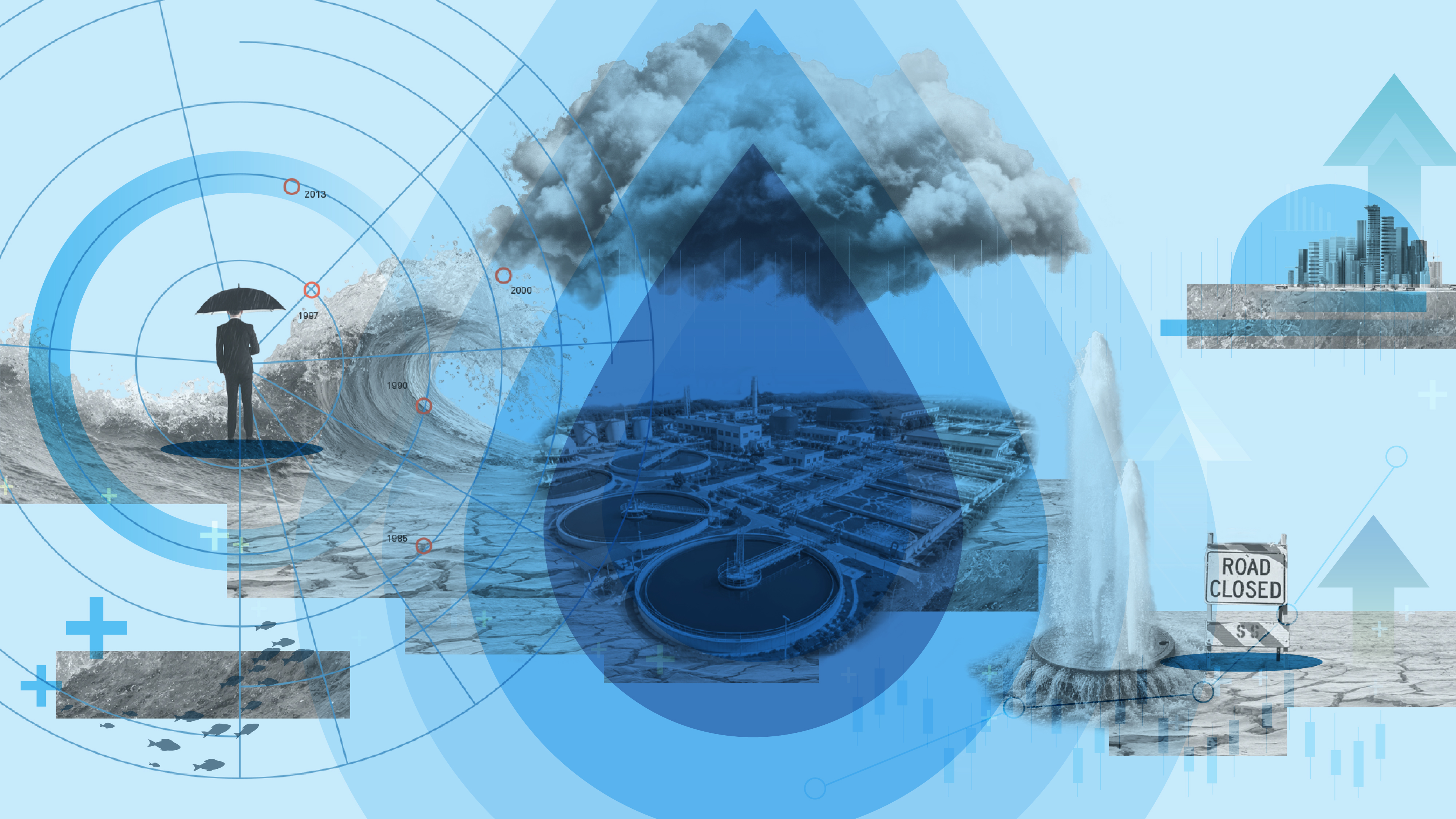
Many utilities are now operating in a world that no longer behaves the way their infrastructure was designed to handle. As climate conditions continue to swing between extremes like flooding and drought, utilities can look to the Water Utility Climate Alliance (WUCA) Climate Resilient Engineering Design Guidance for the Water Sector to navigate uncertainty.
Created in collaboration with 14 of the nation’s leading water providers, the WUCA Engineering Design Guidance translates the climate resilient practices working across the country into actionable engineering decisions that utilities can customize to their specific and regional needs.
So how do utilities confidently service the future of their communities?
What water extremes mean for utilities
Real-time conditions are variable. The same geographies can experience both water excess and scarcity—and they must continue to deliver, regardless of conditions. In the face of rapidly shifting hydrologic patterns, utilities are looking away from historical hydrology and climate assumptions to design infrastructure that can safely serve communities through future climate scenarios.
“When you zoom out, what’s striking is that water utilities are being asked to operate in a system that no longer behaves like the one their infrastructure was designed for.”
- Karri Ving, Project Lead and Managing Principal in Functional Resilience at Brown and Caldwell
Resilience influences reputation and reliability. Utilities aren’t just managing physical systems—they're managing financial exposure, regulatory expectations, and public trust. Resilience is an indicator that influences long-term insurability, creditworthiness, ratepayer confidence, and service reliability.
“Water quality and service continuity are inseparable. The WUCA Engineering Design Guidance frames assets as part of a larger system that supports public health, regulatory compliance, and trust.”
- Karri Ving
This WUCA Engineering Design Guidance leads the industry away from siloed success stories into a shared responsibility to create capacity for reliability across the sector.
Proactively designing for variable conditions
Designing for flooding starts with understanding design-flood elevation. Establishing a design-flood elevation provides a clear benchmark for decision-making. When utilities quantify the possible flood conditions an asset could face, they can make design choices that protect the asset and its operation.
During flood events, what fails are the components that were never intended to be underwater—electrical equipment, controls, access routes, chemical storage, or critical operational spaces. Knowing the design-flood elevation helps utilities determine when to elevate assets, floodproof facilities, relocate equipment, or design systems to safely withstand periodic inundation. Small design decisions made early can significantly reduce operational disruptions and recovery costs later.
WUCA Member Agency, Philadelphia Water Department, worked with Brown and Caldwell to reduce the impacts of flooding from the Schuylkill River. The Belmont Raw Water Pump Station Adaptive Management Plan mapped pathways for initial design strategies along with flexible solutions that could be implemented over time as conditions change.
The WUCA Engineering Design Guidance translates risk into action. These proven solutions are what resilient utilities across the country rely on to keep their systems operational and communities safe through extreme precipitation and flooding events.
Operators are key to safely operating stressed systems. How are systems actually operated and maintained under different climate conditions? To fully integrate operations and maintenance (O&M) considerations into the WUCA Engineering Design Guidance, the team embedded day-to-day operational realities such as staffing, safety, and maintenance cycles as key design inputs. With human safety central to the decision-making criteria, utilities can evaluate which solutions could successfully be operated under stress—all while supporting staff safety and decision-making during fluctuating climate conditions and water supply.
Account for volatility, not just extremes. Riverine flooding, sea level rise, drought, extreme precipitation, and rising groundwater continue to test the resilience of water and wastewater systems across the country. Overlapping pressures mean that a variety of climate conditions must be considered early in the design process.
“These guidelines are less about inventing new solutions and really more about making best practices visible, structuring them in a way that can be applied consistently, and embedding them into the default way that projects get delivered.”
- Karri Ving
To make climate projections tangible, a dedicated chapter in the WUCA Engineering Design Guidance provides methods, examples, and checklists for practitioners. It encourages utilities to avoid single design point assumptions in favor of systems that function across wider flow ranges.
The LongView™: ongoing nationwide collaboration
The WUCA Engineering Design Guidance brings actionable resources to the water sector so utilities can navigate evolving climate risks with confidence. The peer-to-peer, nationwide collaboration sets the standard that we continue to work together and leverage our joint wisdom to define the future of climate resilient design.
“At its core, this is much a communications project as it is a technical one. It’s about fostering collaboration between climate scientists, adaptation specialists, engineers, designers, planners, and utility staff who are responsible for building and maintaining infrastructure every day. The goal is to help those groups work together more effectively so that every dollar spent in a capital program is also a step toward resilience.”
- Karri Ving
In part 3, we will explore how can utilities remain operational to their communities—even through downstream impacts of climate events?