

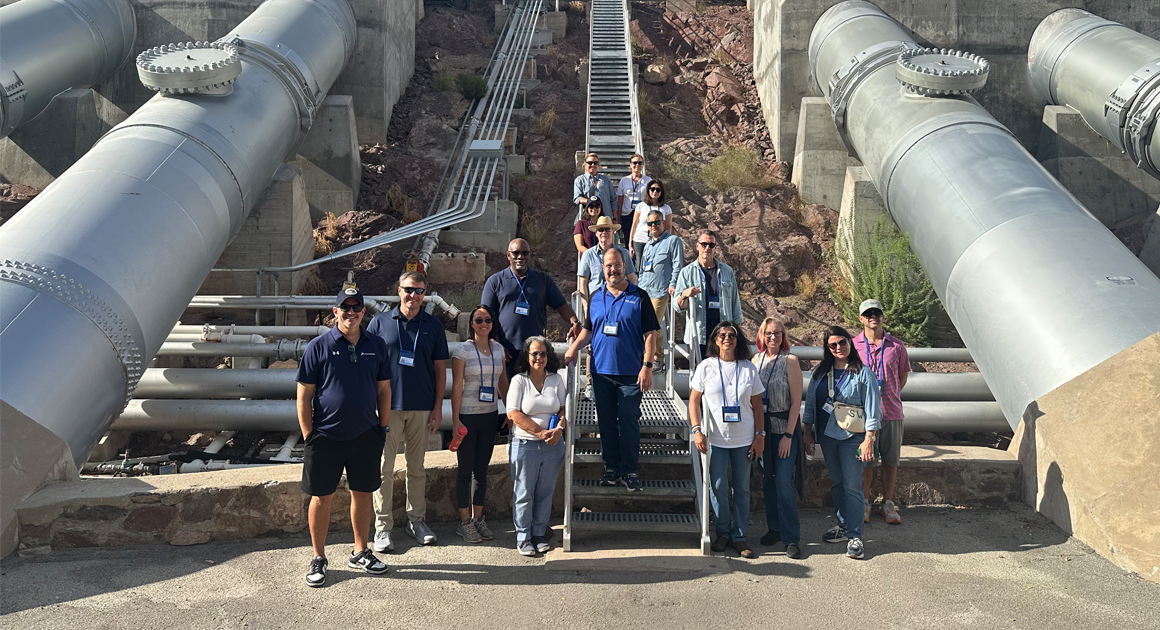
For most Southern Californians, turning on the tap is an everyday act—one that rarely prompts a second thought about where that water comes from or the infrastructure required to deliver it. On a tour of the Colorado River Aqueduct (CRA) led by Metropolitan Water District of Southern California (Metropolitan), Brown and Caldwell’s Los Angeles Local Leader, Chris Kindle, saw that system up close—truly understanding the scale, complexity, and importance of one of the Nation’s most critical water conveyance systems.
The tour highlighted:
-
The infrastructure Metropolitan operates to provide water to millions of residents in Southern California.
-
The partnership between the stakeholders who rely on the Colorado River for that water.
-
The relationship between the urban and agricultural users in Southern California.
Connecting the Colorado River to communities across Southern California
Metropolitan’s mission is to provide its service area with adequate and reliable supplies of high-quality water to meet present and future needs in an environmentally and economically responsible way. Metropolitan distributes to 26 member agencies, which then deliver it to the taps of 19 million Southern California customers across 5,200 square miles. Brown and Caldwell supports Metropolitan’s mission by providing engineering and construction consulting services across the region, including design services for existing infrastructure and program management support for upcoming water reuse projects.
To show the critical role the CRA plays in Southern California’s agricultural economy, Nancy Sutley, Metropolitan Water District of Southern California Vice Chair (City of Los Angeles) and Marsha Ramos, Metropolitan Board Member (City of Burbank), hosted a two-day tour across the Colorado River Basin in September 2025.
This tour focused on the Colorado River Aqueduct (CRA), a 242-mile system comprised of open canal, tunnels, siphons, and pump stations that carries millions of gallons of water a day from the Colorado River across the desert to sustain people, farms, businesses, tribal nations, and wildlife across Southern California.
For Chris, the opportunity to see the CRA up close wasn’t another technical site visit—it was access to revolutionary 100-year-old engineering infrastructure that most people don’t get to see.
He said, “Being able to see the size and scale of the infrastructure up close, you really understand the magnitude of the system. In most of the work we do, we’re almost always under 500 horsepower. Every once in a while we’ll get to pumps that are 2,600 horsepower. By contrast, pumps along the Colorado River Aqueduct are on an entirely different level: the pumps at Julian Hinds are 26,000 horsepower.”
As someone who has been in the water industry for 20 years, Chris anticipated gaining a better understanding of Metropolitan’s conveyance system, but the tour brought to life a deeper level of complexity. From how agricultural users interact with the aqueduct to how water rights and flows are managed across interconnected systems—the trip underscored the importance of the regional water system for not just the water supply, but the State economy and regional food supply.
Trip Highlights (Photo Tour)
The trip included a chartered bus ride where Robert (Bob) Keeran (Coachella Valley Water District, retired) pointed out water infrastructure along Interstate 10.
The group stopped in Palm Desert for a luncheon presentation. Guest speakers John Brooks (JB) Hamby with Imperial Irrigation District (IID) and the current principal negotiator for California on the Colorado River, and IID Director Gina Young Dockstader discussed water policy among various stakeholders receiving water from the Colorado River.
The group learned that the Colorado River supports an agricultural economy worth $2.6B and that agricultural users have the most senior water rights. Spinach and lettuce make up a combined value of more than $470M and cattle, nearly $530M.
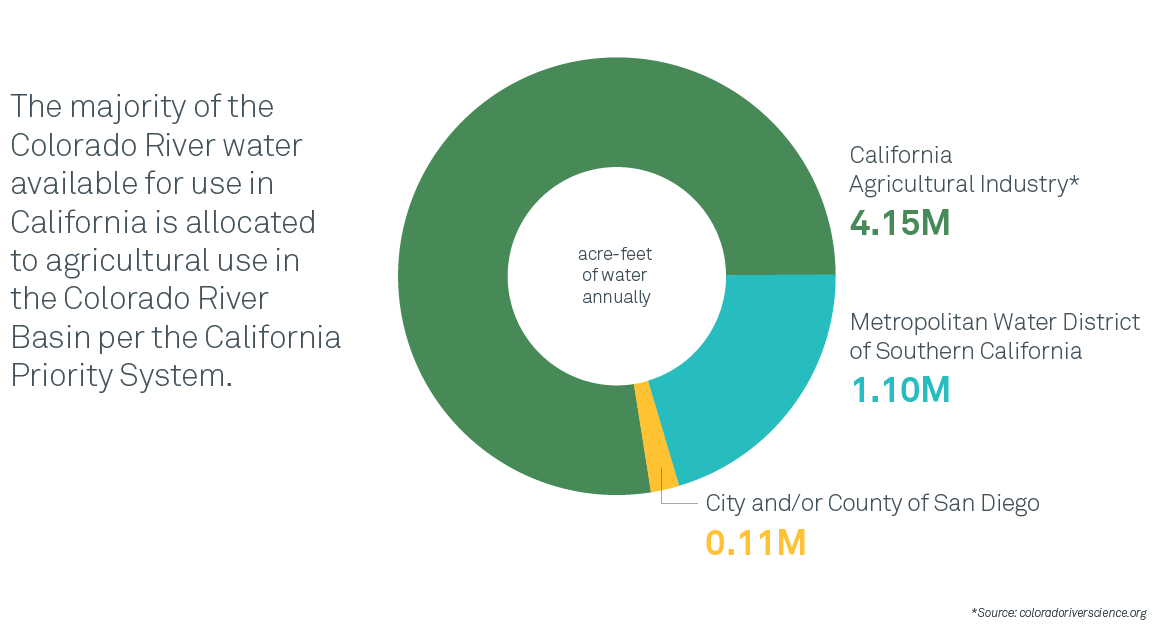
The tour then headed east where they stopped in Blythe for agricultural presentations from representatives of Palo Verde Irrigation District (PVID). PVID is the most senior water rights holder from Southern California for a take from the Colorado River. PVID does not meter the water it takes from the Colorado River but receives credit for water returned to the CRA. Then, farmers in PVID’s distribution pay a water toll as a flat fee for water per acre for the year.
Following the presentation at PVID’s offices, the group visited a 3,600-acre farm that grows alfalfa and cotton.
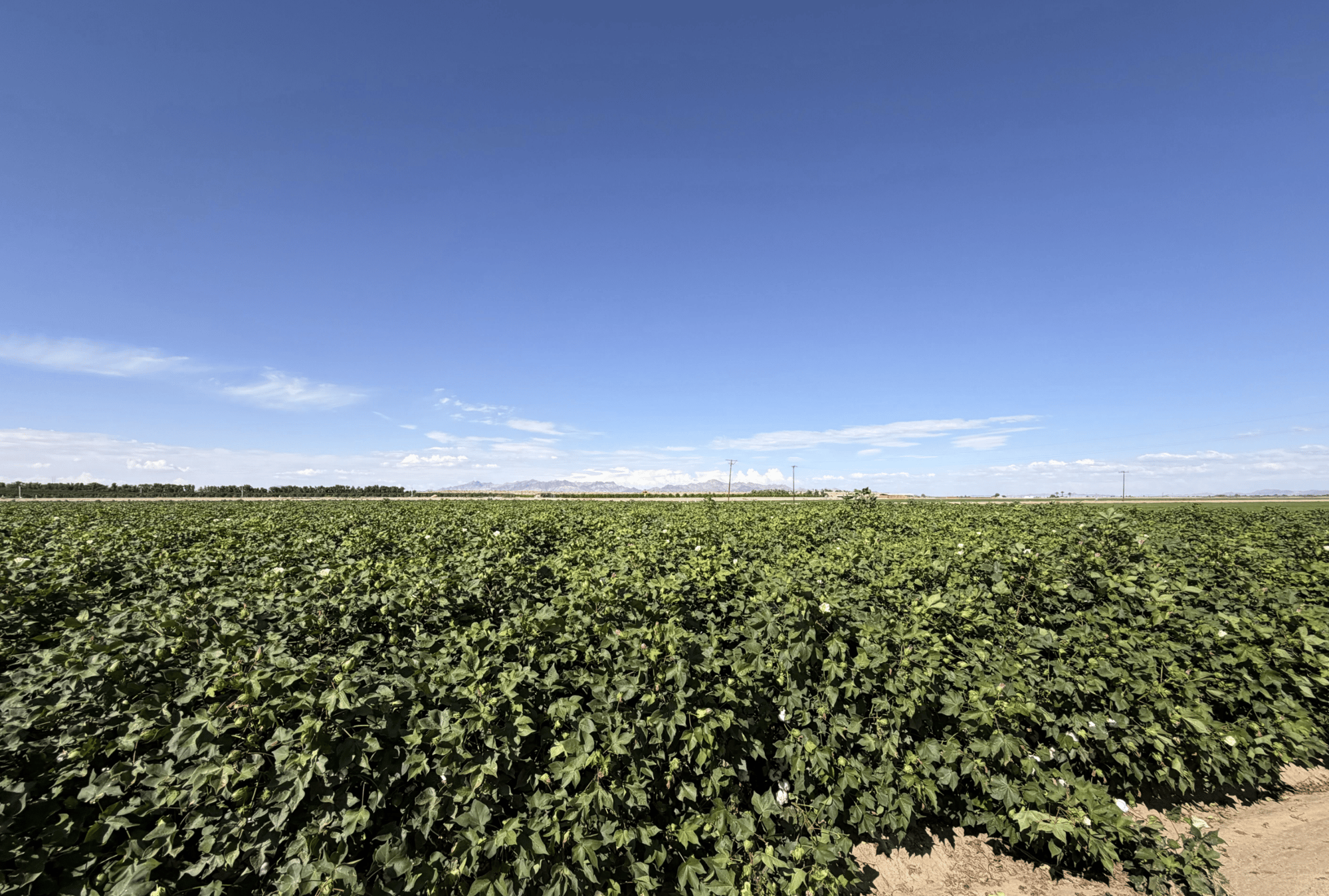
Cotton field and raw cotton at farm in Blythe, CA at Hadley Fruit Orchards, founded in 1931. Hadley Fruit Orchards expanded by investing directly in date orchards, food processing, and retail operations, becoming a well‑known producer of dates, dried fruits, nuts, and specialty foods.
The group departed the cotton fields and headed for Gene Camp for a group dinner and to spend the night. Gene Camp, located at Gene Pumping Plant, is the second pump station Metropolitan operates on the CRA. Some of the pumping plants are in remote locations, far from even small-sized cities, so they have accommodations where operators live in single family homes on the property. Gene Camp also has guest accommodations where visitors or contractors can stay during tours or maintenance and construction projects.
On the second day, some from the group participated in a sunrise hike to get an up-close look at the Gene Pump Station discharge piping, siphon, and other station infrastructure. The guides also provided information on plants, animals, recreation, and the lives of station operators—not only at Gene but at other stations on the CRA.
Chris said, “I’ll never forget the sunrise hike. Coming up to the top of the hill and walking back down to the facility—I could really see the size and scale of the siphon and pump station building. That vantage point was really striking to me. The magnitude of the system is impossible to ignore.”
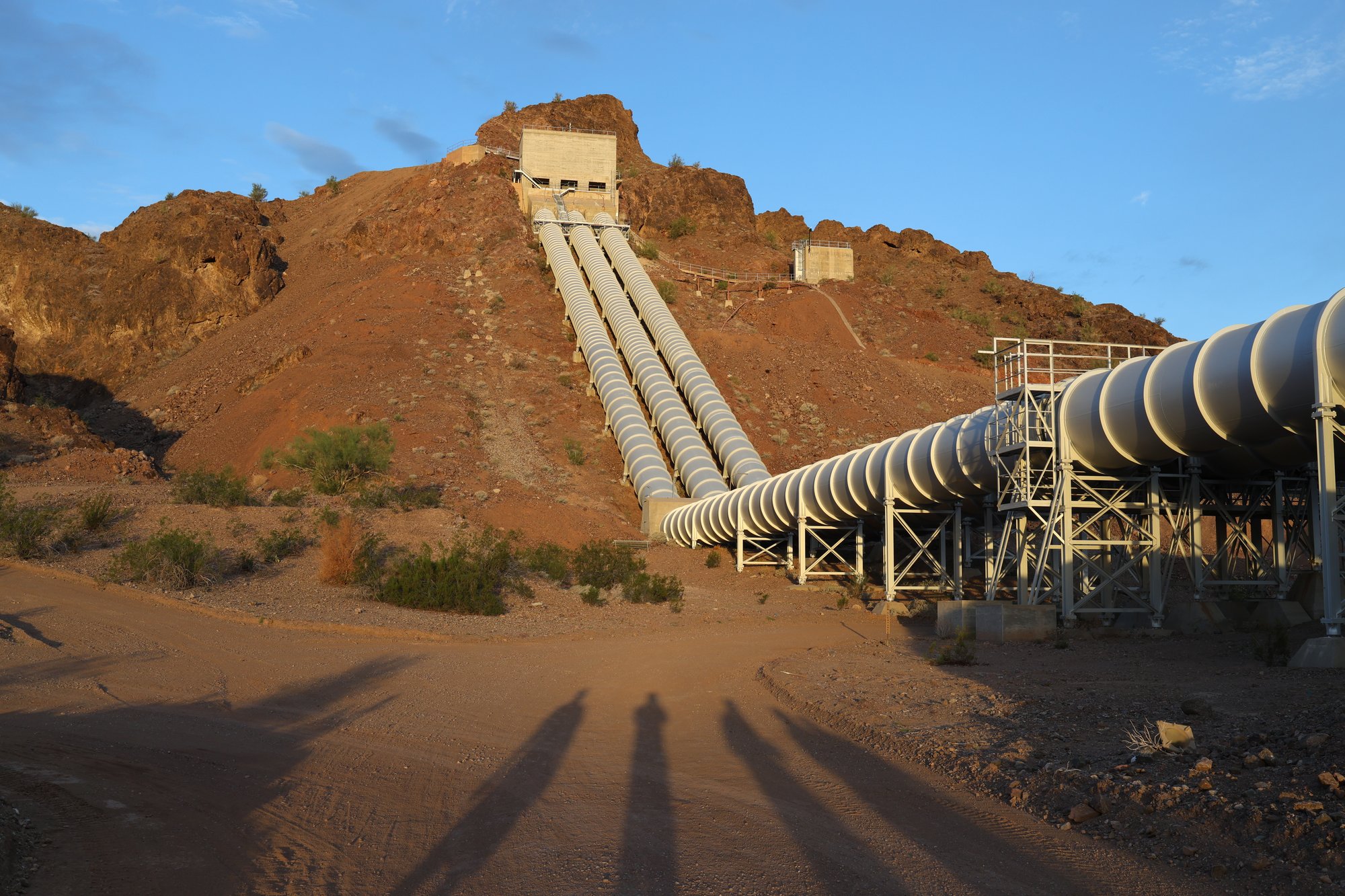
Gene Pump Station discharge piping, the second Pump Station on the Metropolitan system.
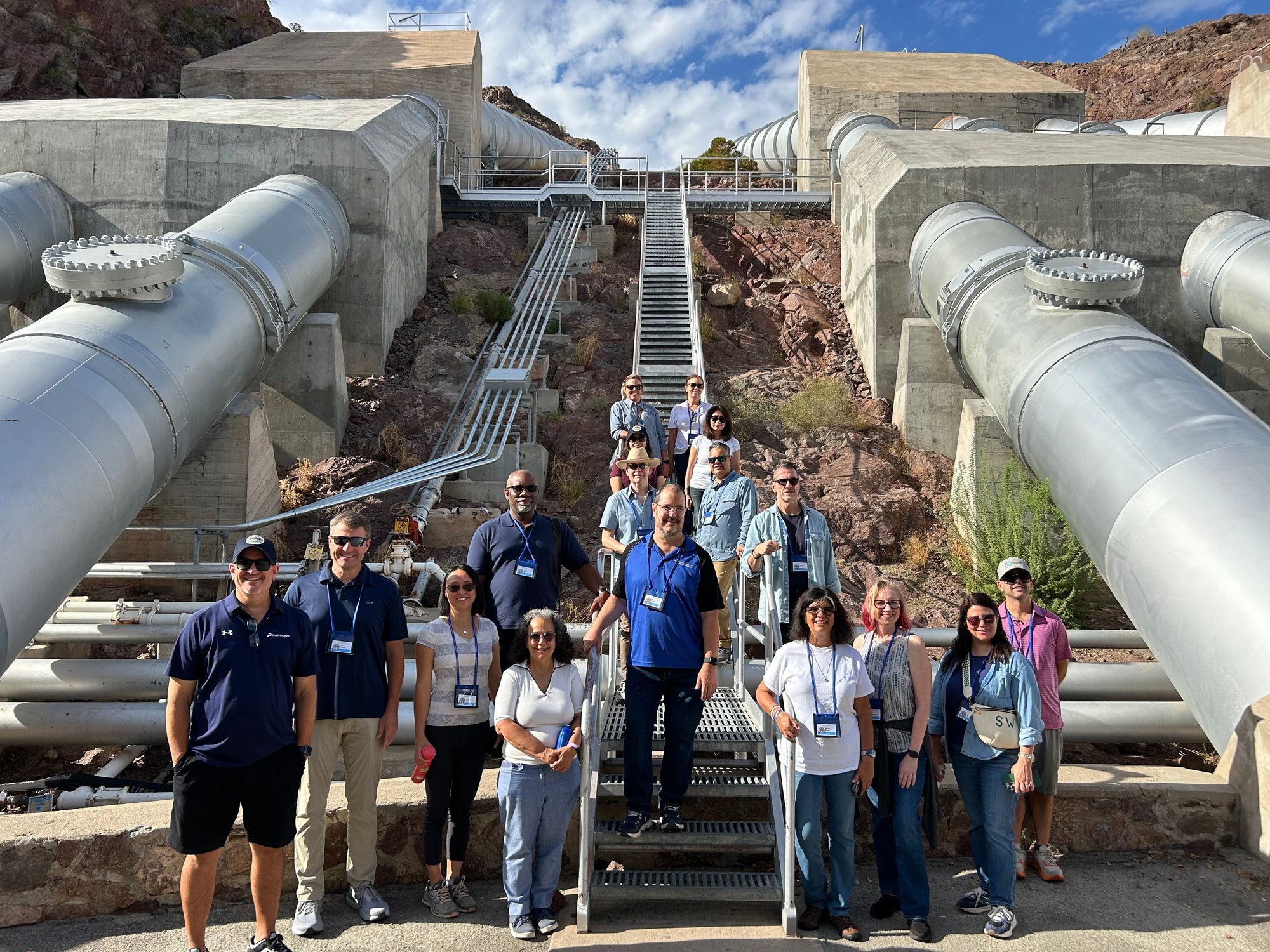
Tour group at Intake Pumping Plant, the first pump station on the Metropolitan system.
After the hike and group breakfast, the group toured the William P. Whitsett Intake Pumping Plant, located on the California shores of Lake Havasu, which is the beginning of the CRA. Whitsett Intake is the first of five aqueduct pumping plants and it lifts water from the Lake 291 feet up to Gene Wash Reservoir and Gene Pumping Plant.
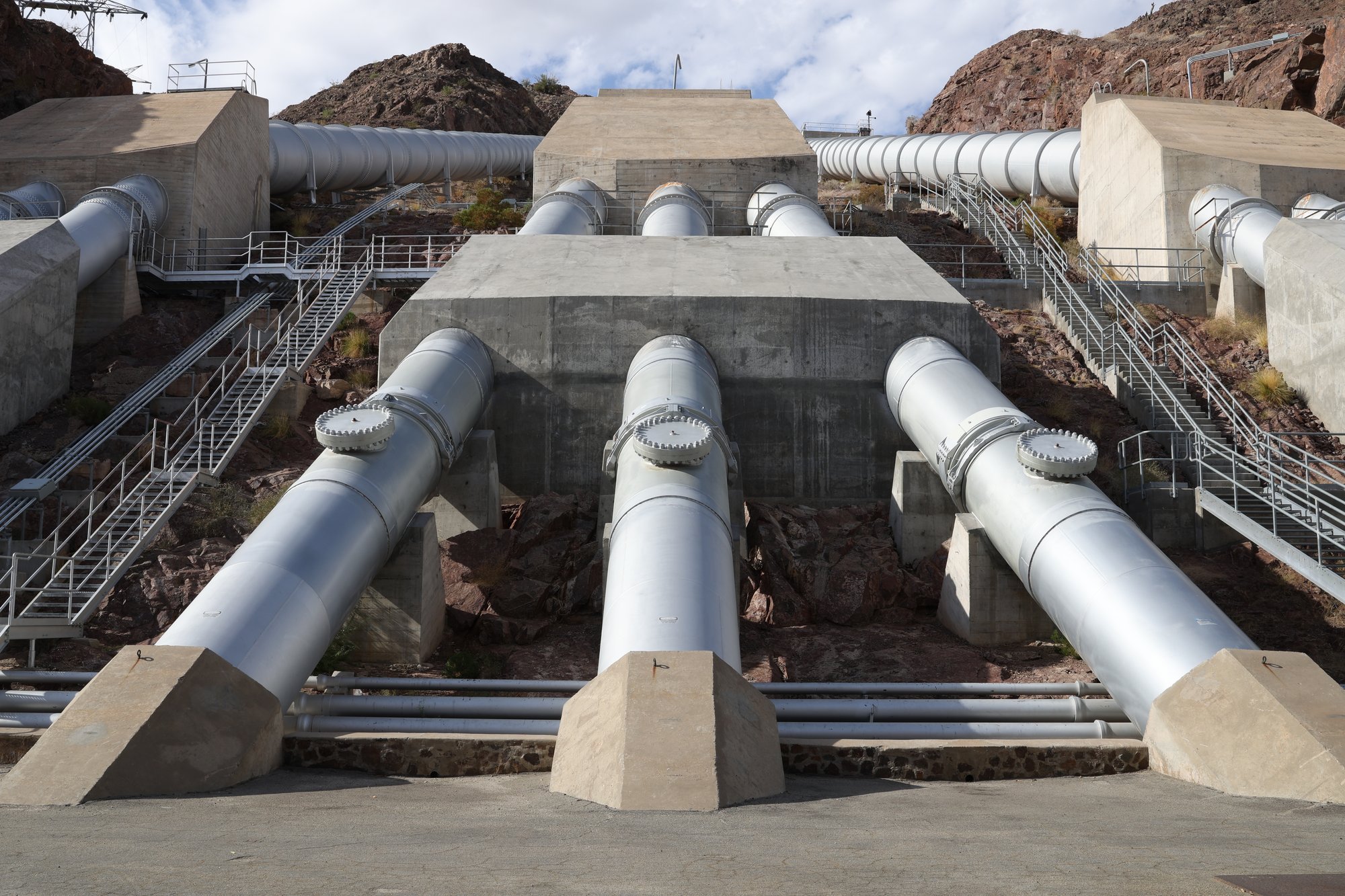
Three of nine pump discharges at Whitsett Intake Pumping Plant.
The group proceeded to Parker Dam, which is the dam that creates Lake Havasu, and was then off to Palo Verde Dam which is where PVID takes from the Colorado River.
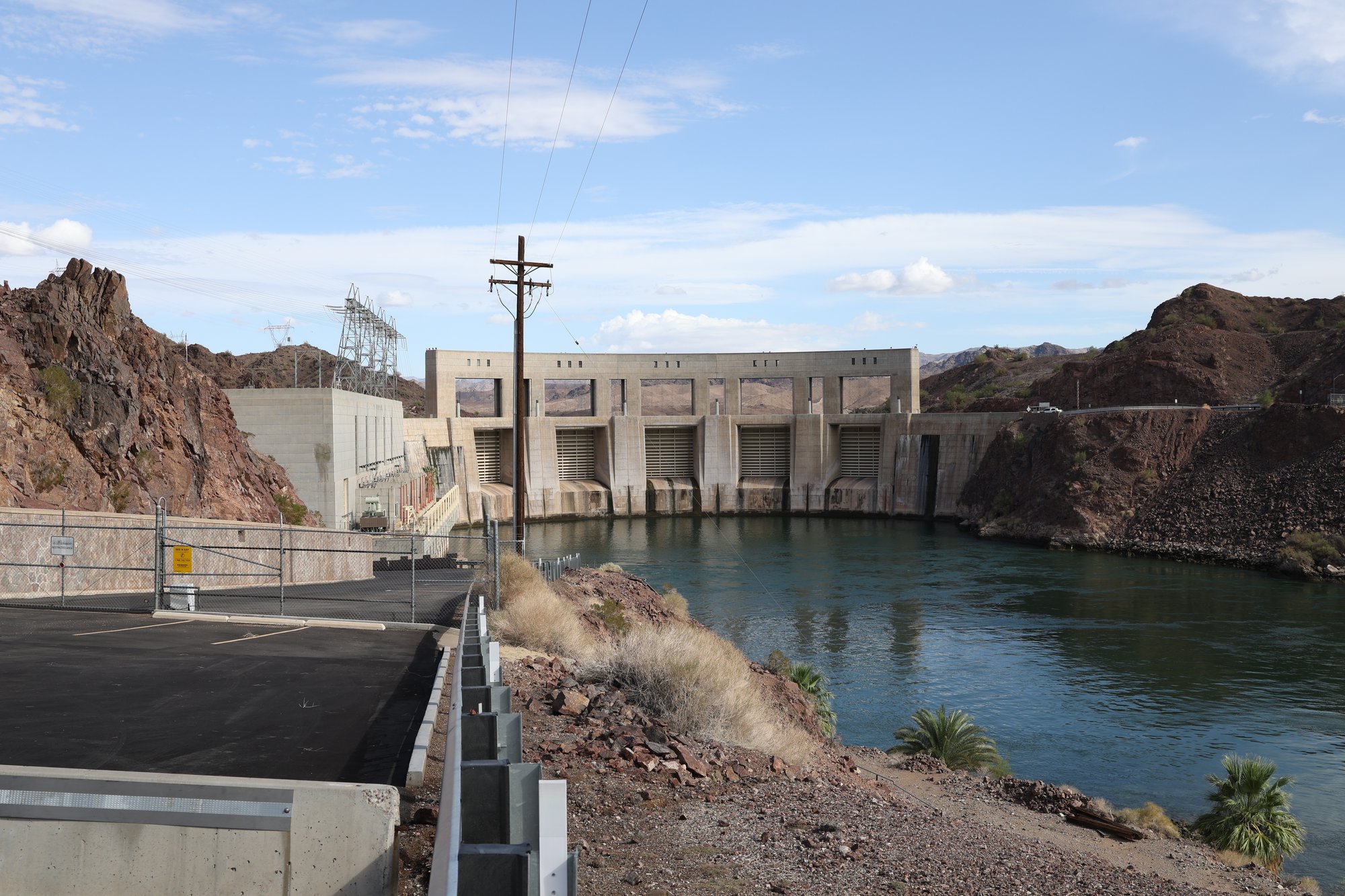
Parker Dam.
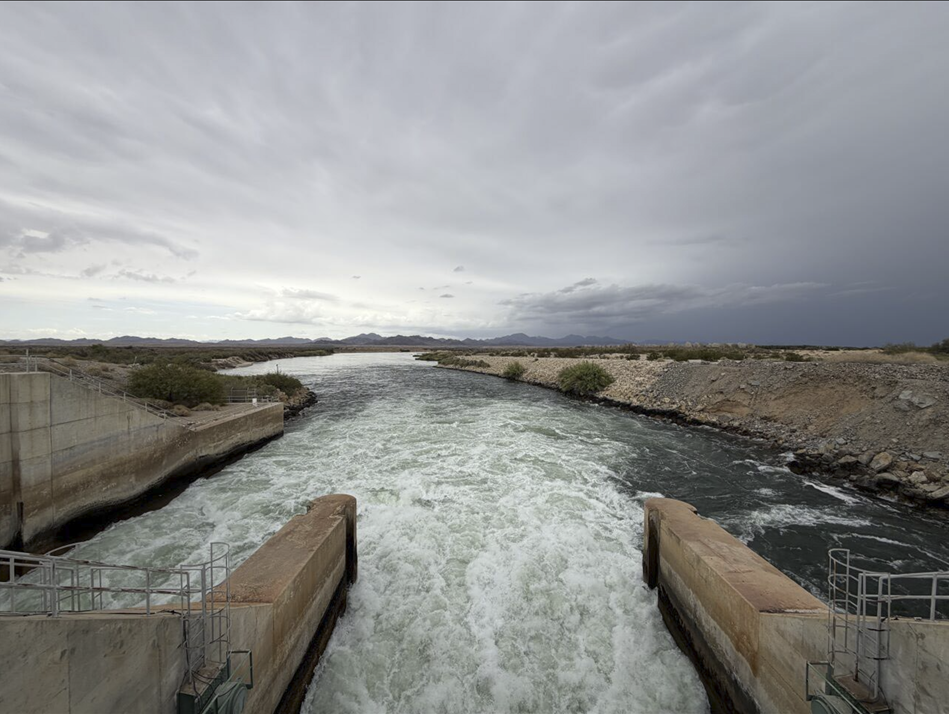
Palo Verde Irrigation District Dam.
The next stop was Hayday Farms, a 15,000-acre facility that grows alfalfa and winter vegetables. In consultation with a California University, Hayday is testing alternative irrigation and farming methods, investigating ways to reduce water consumption. With Hayday’s traditional farming methods compared to their alternatives, they observed higher crop yields of higher quality, while using less water, after the first year of testing. While results are promising, a few more growing seasons will allow them to more definitively determine if the alternative methods are right for them.
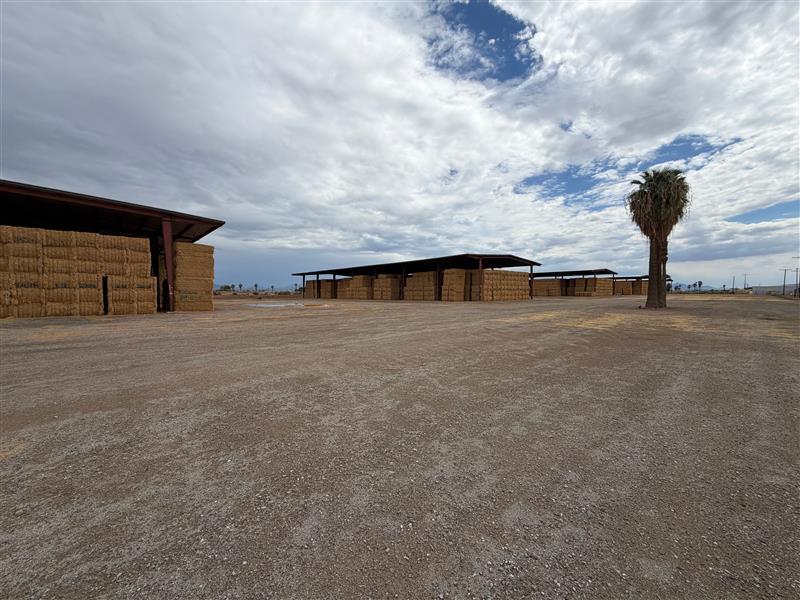
Alfafa storage at Hayday Farms. HayDay Farms is a hay grower and exporter in Southern California, with farming projects spanning over 12,000 acres. The company is involved in planting, harvesting, research, exploration, development, storage and distribution of various crops, including sundengrass, Bermuda grass, ryegrass, kleingrass, alfalfa, oathay, hay cubes and timothy grass.
On their return home, they stopped at the General Patton Memorial Museum, home of Metropolitan’s “Big Map.” The topographically accurate “Big Map” of Southern California was commissioned in 1928 by Metropolitan. It is made of 269,000 individual fiber board pieces that were assembled by hand by 12 artisans. The map weighs close to five tons and traveled to Congressional hearings in Washington, D.C. to help garner support for the Colorado River Aqueduct. The map was donated to the museum in 1988.
Chris’s closing thoughts
The tour brought to life how Metropolitan’s infrastructure delivers water to millions of people across Southern California, and the importance of strong partnerships with the agricultural users for the region’s water supply, food supply, and economy.
When asked how seeing the CRA up close made him feel as a water professional, Chris’s response was immediate.
“Proud,” he said. “Not just of the work we do as an industry, but the responsibility that comes with it. I’m proud to be part of an industry whose work supports 20 million residents of Southern California, along with the millions of visitors who fuel the regional economy each year. This kind of infrastructure—and the people who plan, maintain, and operate it—is foundational to our economy and helps make Southern California the best place on the planet to live.”